
What Is Retainage in Construction? How It Works and How to Track It

Retainage (also called retention) is the part of each progress payment that the paying party holds back until the work is finished. If your subcontract says 10% retainage and your framer bills $40,000 this month, you pay $36,000 now and hold $4,000. That $4,000 is not a discount and it is not your money: it is owed, just later.
It sounds simple. In practice, retainage is where a lot of contractors lose track of real dollars, because it builds up quietly over months, on several subcontracts at once, and is released at a different time from everything else.
Why retainage exists
Retainage gives the paying party leverage to make sure the work gets finished: punch list items closed, warranties and closeout documents delivered, lien waivers in hand. On most commercial jobs it runs in two layers at the same time:
- Owner to general contractor: the owner withholds a percentage of each of your pay applications.
- General contractor to subcontractors: you withhold a percentage of each sub’s pay application, usually mirroring what the owner holds from you.
Because the two layers are linked, a mistake on one side shows up on the other. If you release a sub’s retainage before the owner releases yours, you are financing that sub out of your own cash.
How much is typical?
The most common figures are 5% and 10% of each progress payment. Some contracts start at 10% and drop to 5% (or to zero on new billings) once the job reaches 50% complete. Others hold a flat rate to the end.
Rules vary a lot by state and by type of project. Many states limit how much retainage can be held, especially on public work, and some set deadlines for releasing it after completion. Some of those rules also apply to private projects. What applies to your job depends on the state, whether the project is public or private, and what the contract says. This article is general information, not legal advice: check your state’s rules and talk to a construction attorney before you set or dispute a retainage percentage.
A simple example
Say you have a $200,000 electrical subcontract with 10% retainage, billed over four months:
| Pay app | Work billed | Retainage held (10%) | Paid to sub | Retainage to date |
|---|---|---|---|---|
| #1 | $30,000 | $3,000 | $27,000 | $3,000 |
| #2 | $60,000 | $6,000 | $54,000 | $9,000 |
| #3 | $70,000 | $7,000 | $63,000 | $16,000 |
| #4 | $40,000 | $4,000 | $36,000 | $20,000 |
After the last pay app, the sub has billed 100% of the contract, you have paid $180,000, and you are holding $20,000. That $20,000 is a liability on your books until you release it. Multiply that by every trade on the job and retainage can easily be one of the largest numbers you are carrying.
When retainage is released
Release is normally tied to a milestone written in the contract. The most common ones are:
- Substantial completion: the project (or the sub’s scope) is complete enough to be used for its purpose, often confirmed by the architect or owner.
- Final completion: punch list finished, closeout documents delivered (warranties, O&M manuals, as-builts), and final lien waivers received.
- Partial release: some contracts allow releasing part of the retainage earlier, for example to a sitework or foundation sub who finishes in month three of an eighteen-month job.
Early-finishing trades are a common source of friction. Your concrete sub may wait more than a year for retainage on work that was done and accepted long ago. If your contracts allow line-item or trade-by-trade release, use it, but only when the owner’s side allows you to get paid for it too.
Before you release, most contractors collect a final (unconditional) lien waiver from the sub and confirm the sub’s own suppliers are paid. Lien waiver forms and requirements are also set by state law, and some states have statutory forms you must use. Again: check your state.
Where retainage tracking goes wrong
When retainage lives in a spreadsheet, the same problems come up again and again:
- Retainage is calculated on the wrong base. It should be calculated on work completed (and sometimes stored materials, if the contract says so), not on the payment after other deductions.
- Change orders are left out. When a sub’s contract goes up by an approved change order, retainage applies to the new work too. If the change order lives in another file, the retainage number is wrong.
- The rate changes mid-job and nobody updates the formula. A reduction from 10% to 5% at 50% complete must apply to new billings only, unless the contract says otherwise.
- Release is recorded as a normal payment. Then the report says the sub was overpaid, or the retainage balance never goes to zero.
- Nobody sees the total. Each sub’s sheet is right, but nobody knows the company is holding $180,000 across all jobs, and the owner side is holding $250,000 from you.
How to track retainage properly
Whatever tool you use, these are the pieces you need for every subcontract:
- Contract value, including approved change orders.
- Retainage rate, and any rule for reducing it.
- Each pay application: work completed this period, retainage withheld, amount paid, date.
- Running totals: billed to date, paid to date, retainage held to date, balance left to bill.
- Release record: date, amount and the documents received (final waiver, warranty, closeout items).
And at the project level, two numbers side by side: retainage you are holding from subs and retainage being held from you by the owner. The gap between them is a cash flow number worth watching every month.
A short checklist for your next job
- Read the prime contract’s retainage clause before you write subcontracts, so the two match.
- Write the retainage rate, reduction rule and release conditions into every subcontract.
- Record retainage on every pay app, on work completed, including change order work.
- Review total retainage held and owed once a month.
- Release only against the documents the contract requires, and record the release separately from progress payments.
- Check your state’s prompt-payment and retainage rules, and ask an attorney when in doubt.
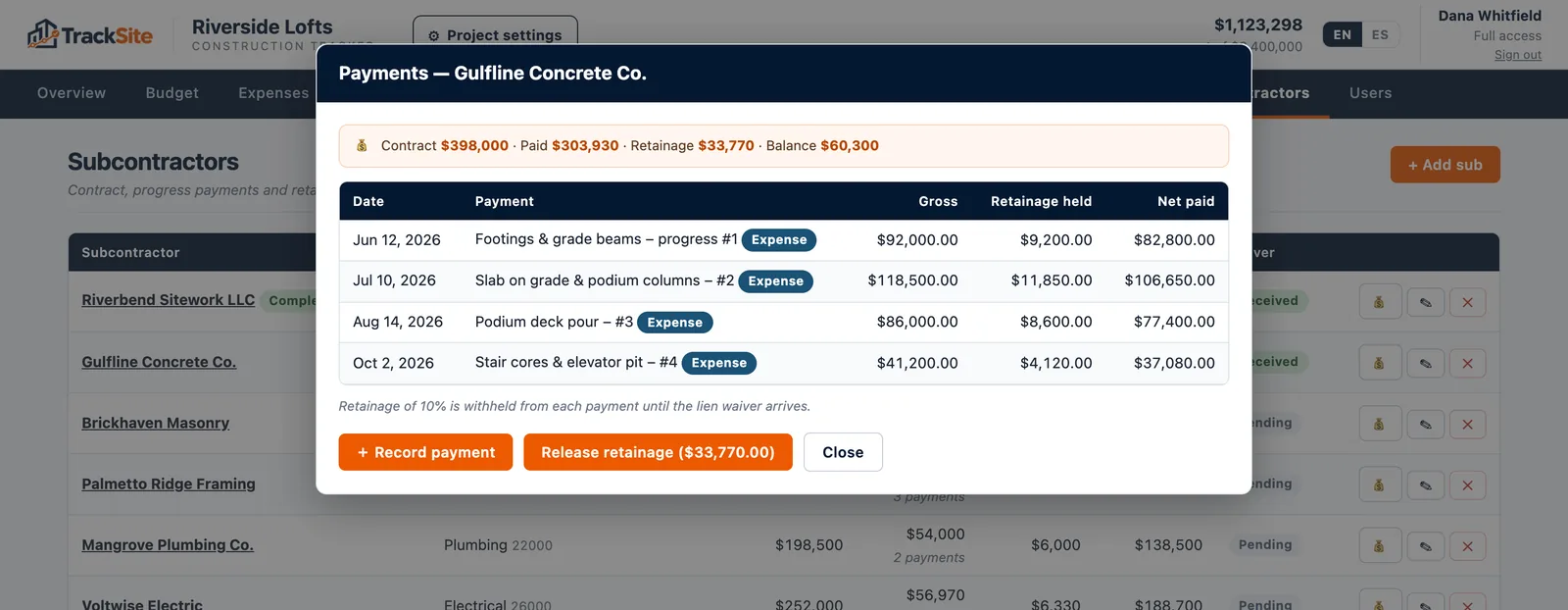
How TrackSite handles it
In TrackSite each subcontractor has a contract, a retainage rate and a list of pay applications. Every pay app records the work billed and the retainage withheld, so the running totals (paid, retainage held, left to bill) are always up to date, and approved change orders roll into the project value. When the sub finishes, you release the retainage with one click and it is recorded as a release, not as another payment. The project overview shows total retainage held at a glance.